



ORGANS OF PARIS © 2026 Vincent Hildebrandt HOME ALL ORGANS
Notre-Dame du Liban
17, rue d'Ulm, 75005 Paris



Constructed circa 1893–94 by architect Jules-
Godefroy Astruc, it was allocated by the Jesuit
Fathers of Sainte-Geneviève school in Paris.
Following the 1905 French law on the
Separation of the Churches and the State, the
Jesuits left it and the chapel was then assigned
in 1915 to the Maronite worship.
In 1937, the Franco-Lebanese home was built
around the parish.
Renovations of the roof, canopy and rose were
made in 1990-1993.
Nowadays, this church is part of the Maronite
Church, for worship of Eastern Catholic
tradition, who has given it the title of ‘cathedral’.



E6
The organ at Notre-Dame du Liban was built between 1910 and
1920 by Abbé Tronchet, an organ builder from Nogent-le-Rotrou.
It was donated to the parish around 1970. Originally, it was a
salon organ with 10 stops, 2 manuals, and pedals.
Today, they use an electronic organ.
The organ in the old Sainte-Geneviève school chapel (see photo,
builder unknown) disappeared and was replaced in 1934 by a
radio-synthetic organ designed by Abbé Jules Puget, inaugurated
on 28 April 1934 by Léonce de Saint-Martin.
Already by the late 1930s, the instrument was abandoned, and in
1942 some of its pipes were reused in the organ at Sacré-Cœur in
Bourbon-Lancy (Saône-et-Loire department).
Later, a 2-manual mechanical organ without a case was installed,
owned by Philippe de Brémond d’Ars, organ professor at the
École César-Franck and organist at the Dominican chapel.
That organ was in turn replaced around 1970 by the Abbé
Tronchet organ.
Source
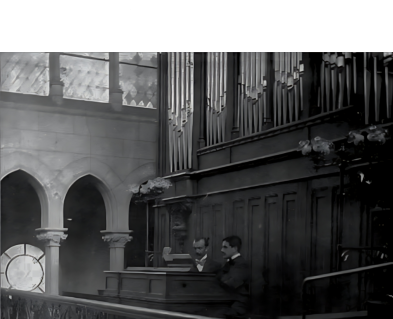
The radio-synthetic organ designed by Abbé Jules Puget.
This instrument was a truly unique curiosity. It was developed by Léonce de Saint-Martin—later organist of Notre-Dame
Cathedral—and his physics teacher Abbé Puget, and built in 1934 by the Société fermière des Établissements Cavaillé-Coll.
What set this instrument apart was that all the pipework was housed in three separate chambers away from the church
space, with the sound not projected directly into it. Instead, microphones in the organ chambers captured the pipe tones,
which were partly synthetically altered or amplified, and output exclusively through three loudspeakers. At its core, it was a
multiplex organ with 16 real ranks of pipes. The total of 51 stops came partly from traditional extensions and transmissions,
and partly from electronically synthesizing the overtones of the sounding pipes.

Silent








Organs of Paris


ORGANS OF PARIS © 2026 Vincent Hildebrandt
E6
The organ at Notre-Dame du Liban was built between 1910
and 1920 by Abbé Tronchet, an organ builder from Nogent-
le-Rotrou. It was donated to the parish around 1970.
Originally, it was a salon organ with 10 stops, 2 manuals, and
pedals.
Today, they use an electronic organ.
The organ in the old Sainte-Geneviève school chapel (see
photo, builder unknown) disappeared and was replaced in
1934 by a radio-synthetic organ designed by Abbé Jules
Puget, inaugurated on 28 April 1934 by Léonce de Saint-
Martin.
Already by the late 1930s, the instrument was abandoned,
and in 1942 some of its pipes were reused in the organ at
Sacré-Cœur in Bourbon-Lancy (Saône-et-Loire department).
Later, a 2-manual mechanical organ without a case was
installed, owned by Philippe de Brémond d’Ars, organ
professor at the École César-Franck and organist at the
Dominican chapel.
That organ was in turn replaced around 1970 by the Abbé
Tronchet organ.
Source
Silent
