




ORGANS OF PARIS © 2026 Vincent Hildebrandt HOME ALL ORGANS
Notre-Dame du Travail
59, rue Vercingétorix, 75014 Paris


E6
The current instrument was built by the Lorraine organ builder
Théodore Harpfer (1946-1999).
It was installed in 1990 to replace the Mutin-Cavaillé-Coll organ
(II/19).
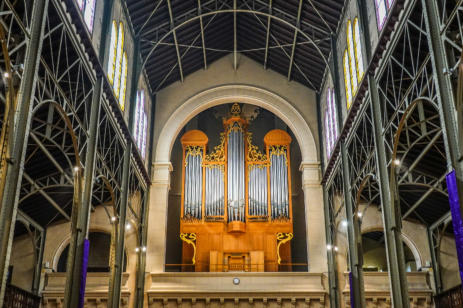
With its "art nouveau" style case featuring a 16' front display,
the organ's special feature is that it has two consoles.
•
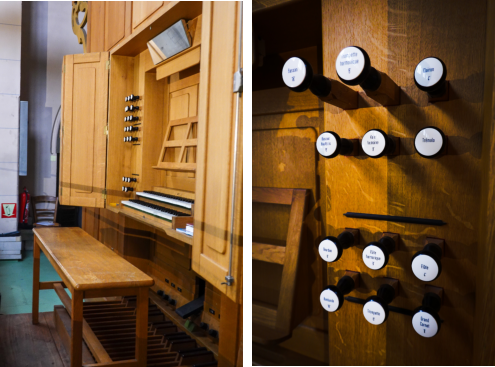
A mechanical tracker console. It has two 61-key manuals
and a 32-step German pedalboard. It plays the Great (I)
stops (except the 16', 8', and 4' chamades), the expressive
Swell (II), and the Pedal (except the two 32' stops). It controls
34 real stops.
•
A mobile electric-action console that plays the full
instrument. It has three 61-key manuals and a 32-step
German pedalboard. It includes 256 combinations, 16 tutti,
and 2 programmable crescendo pedals.
The mobile console will eventually play, beyond those 34 stops,
more than 15 additional ones that aren't installed yet: an
expressive Positif division (II) and the two 32' Pedal stops aren't in
place as of now.

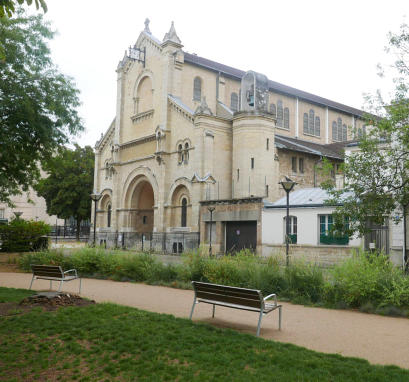
The Notre-Dame-du-Travail church, built at the turn
of the 19th and 20th centuries, boasts one of the
most original interiors around, thanks to its
massive exposed metal framework all painted gray.
It's the work of architect Jules Astruc, whose style
was clearly influenced by Gustave Eiffel and Victor
Baltard. The metal structure is seriously impressive:
40 m long, 20 m high in the central section, and
weighing 135 tons.
1991 - Théodore Haerpfer (1)
1998 - Dargassies (6)
II/34 - console tribune (mechanical traction)
III/37 - console mobile (electronical traction)
stoplist



Titular organist
Jean-Philippe Navez
Parish website
Photos
Orgue : Victor Weller
Eglise : Vincent Hildebrandt








Organs of Paris


ORGANS OF PARIS © 2026 Vincent Hildebrandt
E6
The current instrument was built by the Lorraine organ
builder Théodore Harpfer (1946-1999).
It was installed in 1990 to replace the Mutin-Cavaillé-Coll
organ (II/19).
With its "art nouveau" style case featuring a 16' front display,
the organ's special feature is that it has two consoles.
•
A mechanical tracker console. It has two 61-key manuals
and a 32-step German pedalboard. It plays the Great (I)
stops (except the 16', 8', and 4' chamades), the expressive
Swell (II), and the Pedal (except the two 32' stops). It
controls 34 real stops.
•
A mobile electric-action console that plays the full
instrument. It has three 61-key manuals and a 32-step
German pedalboard. It includes 256 combinations, 16
tutti, and 2 programmable crescendo pedals.
The mobile console will eventually play, beyond those 34 stops,
more than 15 additional ones that aren't installed yet: an
expressive Positif division (II) and the two 32' Pedal stops aren't
in place as of now.
1991 - Théodore Haerpfer (1)
1998 - Dargassies (6)
II/34 - console tribune (mechanical traction)
III/37 - console mobile (electronical traction)
stoplist

Titular organist
Jean-Philippe Navez
Parish website
Photos
Orgue : Victor Weller
Eglise : Vincent Hildebrandt
